



Astrophysicist Farhad Zadeh provides new hypothesis for magnetic filaments in the Milky Way
November 30, 2022
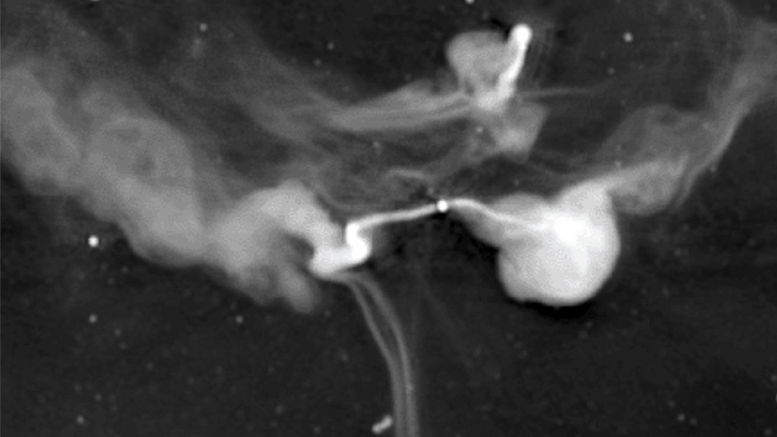
Northwestern University astrophysicist Farhad Zadeh has been fascinated and puzzled by a family of large-scale, highly organized magnetic filaments dangling in the center of the Milky Way ever since he first discovered them in the early 1980s.
Now, 40 years later, Zadeh remains just as fascinated — but perhaps slightly less puzzled.
With a discovery of similar filaments located in other galaxies, Zadeh and his collaborators have, for the first time, introduced two possible explanations for the filaments’ unknown origins. In a new paper, published earlier this month in The Astrophysical Journal Letters, Zadeh and his co-authors propose the filaments might result from an interaction between large-scale wind and clouds or could arise from turbulence inside a weak magnetic field.
“We know a lot about the filaments in our own Galactic Center, and now filaments in outside galaxies are beginning to show up as a new population of extragalactic filaments,” Zadeh said. “The underlying physical mechanisms for both populations of filaments are similar despite the vastly different environments. The objects are part of the same family, but the filaments outside the Milky Way are older, distant cousins — and I mean very distant (in time and space) cousins.”
An expert in radio astronomy, Zadeh is a professor of physics and astronomy at Northwestern’s Weinberg College of Arts and Sciences and a member of the Center for Interdisciplinary Exploration and Research in Astrophysics (CIERA).
Continue reading in Northwestern Now’s story, “The Milky Way’s mysterious filaments have ‘older, distant cousins.’”

Science & Technology

Northwestern accelerates quantum research with NVIDIA technology
September 19, 2025
NVIDIA code could help researchers tackle computationally demanding tasks hindering quantum research Northwestern University physicists are using NVIDIA technology to tackle the computationally demanding tasks hindering quantum research. Northwestern theoretical physicist Jens Koch and his research group…

CRISPR’s efficiency triples with DNA-wrapped nanoparticles
September 18, 2025
New system delivers CRISPR machinery more safely and effectively into cells With the power to rewrite the genetic code underlying countless diseases, CRISPR holds immense promise to revolutionize medicine. But until scientists can deliver its…

Passion for the planet: A new generation of environmental stewards starts here
May 29, 2025
Over the last two decades, the Weinberg College-housed Program in Environmental Policy and Culture (EPC) at Northwestern has embraced the humanities and social sciences and cultivated a new generation of environmental stewards. Growing up in…

Northwestern receives $25 million gift to advance adolescent mental health research
May 16, 2025
New institute will study psychology of emerging adults, leading to innovative wellness programming for students at the University and beyond Northwestern University is launching the Institute for Adolescent Mental Health and Well-Being, an interdisciplinary initiative…